



Table of Contents
Introduction: AI in Industrial Automation
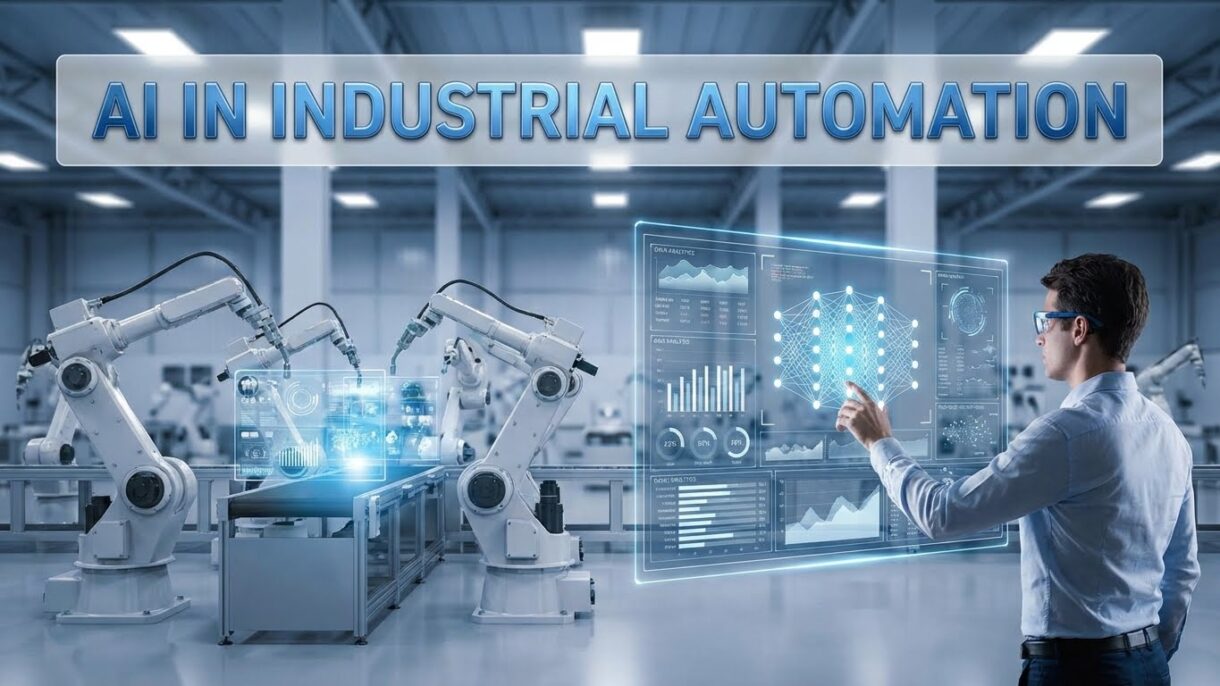
Imagine a factory where systems anticipate failures, robot arms collaborate seamlessly with human operators, and digital twins simulate real-world changes before they happen. That’s the power of ai in industrial automation—a fusion of artificial intelligence and automation reshaping industries. In this deep-dive, we’ll explore how this technology works, who’s leading the charge, what makes it tick, and how you can integrate it into your own operations to stay ahead.
1. Advanced NLP & Entity Extraction: What Competitors Highlight
Across top-performing content, several key entities frequently emerge:
Companies & Platforms:
- Siemens (Xcelerator, Industrial Copilot)
- Rockwell Automation
- ABB, Schneider Electric (EcoStruxure)
- Honeywell (Forge), Emerson (Plantweb)
- Amazon Robotics, Ocado
- Emerging startups: Landing AI, Bright Machines, Realtime Robotics
Technologies:
- Predictive maintenance, digital twins, edge AI, computer vision, IIoT (Industrial Internet of Things)
- Cobots, MLOps, 5G, green automation, autonomous robots
Market Trends & Metrics:
- Market projected to grow from USD 20.2 Bn (2024) to USD 111.8 Bn (2034) at ~18.8% CAGR InsightAce Analytic
- Alternative forecast: from USD 6.35 Bn (2025) to USD 191.76 Bn (2034) Market Research Future
- Rapid short-term growth: from USD 6.08 Bn (2024) to USD 9.12 Bn (2025), and to USD 48.22 Bn (2029) The Business Research Company
- Global industrial automation market projected to reach USD 345 Bn by 2027 GitnuxMordor Intelligence
- AI-driven automation adoption growing at a CAGR of ~23% through 2030 Gitnux
Case Studies & Real-world Use:
- Amazon employing over 750,000 mobile robots and robotic arms with AI in distribution centers, cutting fulfillment costs by ~25% Financial Times
- Ocado’s Grid system handling 40% of robot packing—expected to rise to 80%—using AI-driven robotic arms for complex tasks like lifting oranges The Verge
- Priestley’s Gourmet Delights bakery in Australia opened a $53 million AI-powered smart factory, doubling capacity and promoting sustainability The Australian
- Broader industry insights: AI aiding just-in-time manufacturing, logistics optimization, and supply chain resilience Reuters
2. Prioritizing Entities for SEO & Reader Impact
Based on frequency, relevance, and SEO value, here’s how to prioritize:
Tier 1 – Core Entities:
- Siemens, Amazon, Ocado
- Predictive maintenance, digital twins, edge AI, computer vision, IIoT
Tier 2 – Strategic Entities:
- Schneider Electric, Honeywell, ABB, Emerson, Rockwell Automation
- Cobots, 5G integration, green automation, MLOps
Tier 3 – Underexplored but Valuable:
- Startups like Landing AI, Realtime Robotics, Bright Machines
- Themes like AI governance, industrial AI ethics, humanoid robotics (e.g., Tesla’s Optimus) arXiv
3. Organic Integration Tactics
Headings That Use Entities Effectively
- H2: “Why ai in industrial automation is Driving Predictive Maintenance with Siemens and Edge AI”
- H2: “Digital Twins and Computer Vision: How Amazon and Ocado Revolutionize Warehousing”
- H2: “Smart Manufacturing with IIoT and 5G: The Role of Schneider Electric and ABB”
- H3: “Cobots vs Traditional Robots: Trends from Honeywell to Emerging Startups”
Comparison Table
| Platform/Company | AI Capabilities | Core Industry Applications |
|---|---|---|
| Siemens (Xcelerator) | Digital twins, AI assistant (Industrial Copilot) | Engineering workflows, predictive analytics |
| Amazon Robotics | AI-powered robotics, computer vision | Fulfillment, sorting, logistics |
| Ocado (Grid, OGRP arms) | AI-driven parallel/soft gripping, robotics | Grocery order packing, automation |
| Schneider Electric | Edge AI (EcoStruxure), smart energy controls | Energy optimization, factory monitoring |
Pros & Cons Lists
Pros of Edge AI:
- Real-time responsiveness
- Lower latency than cloud-based AI
- Better reliability under poor connectivity
Cons:
- Higher initial investment in infrastructure
- Requires strong OT cybersecurity

FAQ Section
- What is ai in industrial automation and how is it used?
- How does Amazon use AI in its warehouses?
- Why are digital twins important in industrial automation?
- Can predictive maintenance powered by AI reduce downtime?
- What advantages do cobots offer over traditional industrial robots?
Case Study Narratives
- Amazon’s robotics empire: AI-driven systems powering millions of shipments, improving efficiency and enabling digital twins for simulation workflows Financial Times
- Ocado’s robot-packed groceries: AI arms now handle 40% of orders and aim for 80% soon, mastering complex tasks with advanced gripping The Verge
- Sustainable smart bakery: At Priestley’s, AI-powered autonomous vehicles and cobots doubled production capacity while cutting emissions, blending automation with green tech The Australian
Statistics Mini-Table
4. Tone & Style Suggestions
- Voice: Authoritative yet conversational—avoid jargon-heavy overload.
- Analogies: Think of digital twins as your factory’s virtual shadow, quietly alerting you before something breaks.
- Storytelling: Start a section with “Picture a warehouse where robots lift oranges…” to engage readers.
- Questions: Pose rhetorical questions, e.g., “What if your system could self-heal before failure?”
- Data & Quotes: Use recent figures and citations like “AI-driven automation adoption is growing at ~23% CAGR” to build credibility.
- Formatting: Use bullets, bold key terms, short paragraphs for scan-ability.
- Human touch: Mention decision-makers like Siemens CEO Roland Busch and link AI strategies to industry leadership Wikipedia.
5. Gaining Competitive Advantage
- Multimedia Assets:
- Embed bar charts illustrating market growth (2024–2034)
- Diagram workflow of AI-powered warehouse
- Short video walkthrough of digital twin usage
- Under-Served Topics:
- Governance and ethics of AI in OT environments
- Humanoid robotics like Tesla’s Optimus and human-robot safety standards arXiv
- Startups disrupting the space (Landing AI, Bright Machines)
- SEO Enhancements:
- Implement FAQ schema for featured snippets
- Craft metadata:
- Title: ai in industrial automation: real-world use cases, market outlook & tools
- Description: Explore how AI in industrial automation—from predictive maintenance to digital twins—is transforming manufacturing in 2025+.
- Interactive Widgets:
- ROI calculator: Estimate savings from predictive maintenance
- “Which AI automation platform fits you?” quiz comparing Siemens, Amazon, Ocado, Schneider
- Lead Magnet Idea:
- “The 2025 AI in Industrial Automation Playbook” – downloadable PDF with case summaries, ROI framework, checklist
Conclusion
The era of ai in industrial automation isn’t on the horizon—it’s already here. From Amazon’s robotics revolution to Ocado’s AI-driven grocery fulfillment and sustainable factories in Australia, we see a future that’s smarter, faster, greener. The marriage of digital twins, edge AI, and IIoT is rewriting how industries operate—driving efficiency, resiliency, and innovation.